 Colombia
Colombia - Finca La Sirena - Osmotic Dehydration/Honey Super Fruit 12 KG
11.97 kg, 26.40 lbs / bag
Availability
5 boxes in spot
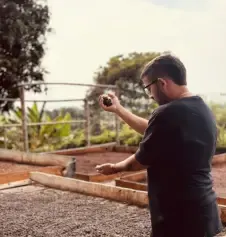
We’ve been purchasing Juan David’s coffees for several years, and his work continues to set a benchmark for experimental processing. With a background in food science and engineering, Juan brings a level of technical precision and creativity that shows clearly in every lot we offer. Over the years, he has refined his signature mossto‑driven osmotic dehydration method—a process in which whole cherries are immersed in a supersaturated solution that draws out moisture and concentrates flavor through controlled chemical gradients. Juan has explored more than 30 co‑fermentation profiles, and his mastery of the technique is evident from the moment you open the bag. Even the green coffee carries the unmistakable aromatics of the final cup. The process begins with harvesting the coffee beans at their optimal ripeness, which are then floated to separate the good from bad. They are then left to ferment in bags for 16 hours, following which they are pulped with the aim to retain as much mucilage as possible. The coffee is placed in sealed bags with peaches, strawberries, rose petal , glucose, and water is added until it reaches a Brix level of 60. After two days, the coffee is removed and taken to drying until it reaches 10% moisture content. During this time, osmotic dehydration occurs, a preservation technique that partially removes water from foods (fruits, vegetables) by immersing them in concentrated solutions (sugar, salt) at moderate temperatures. It causes a transfer of water into the solution and solutes into the food, improving texture, color, and shelf life without drastic phase changes. A gentle heat treatment following osmotic dehydration promotes color and flavor retention, resulting in a product with superior organoleptic characteristics. After 24 hours of anaerobic fermentation, the coffee is removed and washed before being dried. Juan David uses a mixture of drying methods on these coffees. He first needs to stop the fermentation of the coffee, so he uses a mechanical silo to dry to coffee to a humidity of around 25%. After this humidity is reached the coffee is places in “elbas” or movable roofs to direct sun exposure. The coffee will dry until the humidity is around 10 - 11%. All the process can take between 5-7 days. Available exclusively in 12 kg boxes, and certain to sell out quickly, get yours while they're here!